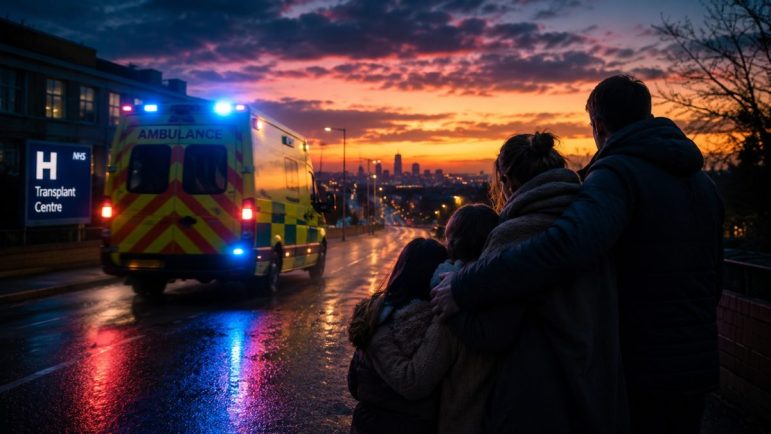
Tonight, somewhere between heartbreak and hope, a miracle is happening.
As I write this, a man I will call T is racing towards London in the back of an ambulance. Blue lights flashing. Family members crying. Phones ringing. Prayers being whispered.
Because tonight, after years of waiting, a liver is waiting for him.
And because one family, on the worst day of their lives, chose to say yes.
Before I tell you about T, I want to talk about organ donation.
Thankfully, things have changed in the United Kingdom. We now have an opt-out system, known as deemed consent. What a wonderful step forward that was.
Unless you actively register a decision not to donate, you are automatically considered willing to become an organ donor after death. You can still formally opt in and record your wishes, but the assumption is now one of generosity rather than hesitation.
Across England, Scotland, Wales and Northern Ireland, adults are generally considered potential organ donors unless they have chosen otherwise.
Families are still consulted. They are always involved. If they know their loved one did not want to donate, they can make that clear. But if you take nothing else from this article, please hear this:
Families, please don’t opt out.
Please don’t.
Because on the other side of your unimaginable grief may be a family desperately waiting for a phone call that could save a life. Tonight, we were that family.
T is not my brother by blood. But he may as well be.
I grew up with him. We spent holidays together. Our families have been best friends for decades. His mum is like a second mother to me. Some friendships become family over time, and ours did.
T was the charismatic one. The kid who could walk into any room and instantly make people smile. The one with the laugh everyone recognised before they saw him. The one with the stories.
Life took us in different directions. I lived in America for fifteen years, and although we didn’t see each other often, we stayed connected through Facebook and mutual friends.
Whenever I came home, my parents would fill me in on everything happening in his life. Every detail. Because that’s what families do.
Then came the devastating news.
T was desperately ill. Alcoholism can run through families. T fought it. The cruellest part was that he blamed himself. But addiction is not a moral failing. It is not weakness. It is not a lack of character. And in T’s case, there was more to the story than most people knew.
A genetic vulnerability, a perfect storm of factors beyond simple choice or willpower. By the time he became sober, and he has now been sober for years, the damage was already done.
His liver was failing.
He developed cirrhosis.
And then came the endless cycle of emergencies, hospital admissions and terrifying close calls.
There were times we thought we were losing him.
A few weeks ago, he was so sick that he would go to the bathroom and vomit blood. His legs swelled to three times their normal size. Every day became a battle just to survive.
You never truly appreciate the liver until you see what happens when it stops working.
It affects everything. Every organ. Every movement. Every breath. Every hope.
Six months ago, things looked so bleak that I wrote to him and offered something I never imagined I would have to offer.
I told him that if the worst happened, I would send Christmas cards and birthday cards to his mother for the next thirty years. I asked him to send me 30 years of messages.
That is how close we thought we were. That is how dark things became. And then tonight, the phone rang.
The call.
The one every transplant family dreams of receiving.
A liver had become available.
A match. A chance. A future.
And yet every miracle comes wrapped in tragedy.
Because while our family is celebrating, another family is grieving.
Somewhere tonight, a wife may be crying herself to sleep. Children may be trying to understand why Dad isn’t coming home. Parents may be staring at a phone they wish would ring one more time.
We know only a few details.
He was a man. He was in his early fifties. He died today after a cardiac arrest. A heart attack stole him from the people who loved him.
And while they were facing the most unimaginable loss, they made a decision that could save another human being.
They chose generosity. They chose compassion. They chose life.
Because of that choice, T may get another chance. A chance to laugh again. A chance to sit with his mum again. A chance to watch another Christmas arrive. A chance to grow old.
They will probably never know him. We will probably never know them. Yet from this moment forward, their loved one’s legacy will live on inside someone who was running out of time. How extraordinary is that?
Organ donation is not simply about organs. It is about hope. It is about choosing life in the middle of death. It is about one family’s worst day becoming another family’s answered prayer.
Tonight, one family is planning a funeral. Another family is daring to dream about the future again.
There are no words big enough to thank the man who gave this gift. There are no words big enough to thank the family who honoured his wishes. But there is gratitude. Endless gratitude.
So tonight, wherever you are, please say a prayer. Say a prayer for the man who died today. Say a prayer for his family, whose hearts are breaking. And please say a prayer for T, who is currently travelling towards London carrying every hope we have for him.
Because tonight, thanks to the selflessness of strangers, he has been given something precious.
Not just a liver.
A second chance at life.