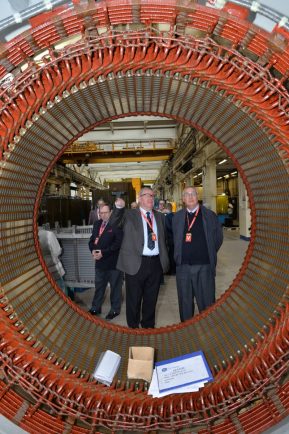


A ‘EUREKA’ moment which changed the world was celebrated at the Rugby factory where it took place 80 years ago.
Dignitaries were invited to tour the site where Air Commodore Sir Frank Whittle OM, KBE, CB first tested his pioneering jet engine to mark the anniversary.
Among the visitors to the GE Energy Connections factory – formerly the British Thomson-Houston Works – were Whittle’s son Ian, Mark Pawsey MP, and members of the Rugby Aviation Group and the Warwickshire Industrial Archaeology Society.
The society’s Alain Foote tells the story of Whittle’s breakthrough.
EIGHTY years ago, on April 12 1937, a steam turbine assembly hall at the British Thomson-Houston works at Rugby resounded to a previously unheard sound – the ear-shattering whine of a totally new form of aircraft propulsion unit: the gas turbine turbojet.
At the controls of the revolutionary engine on that day was its inventor, Flt Lt. Frank Whittle, a serving RAF Officer. It was the practical outcome of an original concept formulated by Whittle some seven years previously, but rejected as impractical by his mentors at the Air Ministry.
The engine, designated the Whittle Unit (WU), was mounted on a test truck situated on a gantry structure above the main steam turbine assembly hall, with the jet efflux pipe projecting through a window from which a pane of glass had been removed. As a safety precaution, thick sheet steel screens had been erected on either side and above the engine, to contain any debris that might be expelled from it in the event of a catastrophic overspeed failure. Additionally, also for safety reasons and not without a degree of resentment, no senior personnel from BT-H were allowed to be present at the first test run.
To say that the actual test run on April 12 had its share of problems would be something of an understatement. The electric starter was used to raise the engine speed and with the ignition active, Whittle then began to open the main fuel control valve. Initially, with a low growl, the engine began to accelerate. But instead of obeying Whittle’s control of the fuel supply, the speed began to rise with the growl changing to an alarming whistling shriek, described in Whittle’s notes as sounding like an air-raid siren. Ominous large patches of red heat also started to appear on the combustion chamber casing, and Whittle watched with horror and disbelief as the speed rose – the engine was totally out of control.
All those present except Whittle made a rapid retreat, taking cover wherever they could. Whittle observed the engine speed peak at 8,000 rpm and then, with immense relief, watched it begin to drop. The shriek died down to a reluctant growl and ceased as the engine came to a standstill. The personnel who had absconded sheepishly returned to their posts. Later Whittle confided in his notes: “Needless to say, this incident did not do my nervous system any good at all.”
So this was the world’s first somewhat eventful run of a turbojet engine. It was to be the precursor of many more alarming tests. A considerable amount of further development work was required to bring the unit to a state where it could be installed and flown in an aircraft. This condition was not attained in Britain until May 15 1941, when the experimental Gloster-Whittle E28/39 piloted by Gloster’s chief test pilot, PEG (Jerry) Sayer, successfully flew at RAF Cranwell, Lincolnshire.
Today we take air travel by jet-powered aircraft very much for granted, with all the benefits that it has bestowed upon mankind in improving communications and shrinking our world.
That giant leap forward was initiated eighty years ago by a Warwickshire man, whose creative genius came to fruition in his own native county.