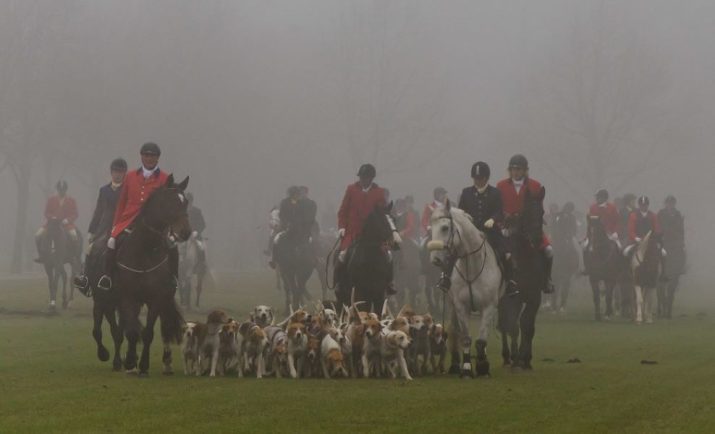
NO ‘INAPPROPRIATE’ influence affected Warwickshire Police’s handling of hunting activity in the county, an independent report has concluded.
The review focused on the force’s response to anti-social behaviour, road safety and crime reporting in relation to hunting in the county.
It follows controversy last year over an alleged ‘secret’ deal between Warwickshire Hunt and Warwickshire Police which sparked widespread anger.
But the review concluded that a Community Protection Notice issued by the force was in response to anti-social behaviour related to the use of roads during trail hunting activities, not in relation to illegal hunting.
When Warwickshire Hunt appealed against the CPN, the confidentiality of a legal settlement between the Hunt and the force was upheld by the Information Commissioner’s Office.
The review also found no evidence to suggest that Warwickshire Police and Crime Commissioner (PCC) Philip Seccombe’s membership of the Countryside Alliance influenced police decision-making.
The report added the force underestimated the level of public and media interest in the issue and relied on a reactive rather than proactive communication strategy – and recommended a more proactive and transparent approach, including providing clear information on how to report incidents relating to hunting and associated anti-social behaviour.
David Peet, author of the review, said: “The review aims to look specifically at Warwickshire Police’s use of a Community Protection Notice to tackle reported incidents of anti-social behaviour by the Warwickshire Hunt, how matters were handled when the CPN was challenged and the decision-making that lay behind this.
“The use of a CPN was clearly focused on addressing anti-social behaviour relating to the use of public roads and not for allegations of illegal fox hunting. Nevertheless, the subsequent work by the force to provide greater clarity on how it polices the wider issue of trail hunting is welcome and, while it is early days, this feels like a step change in the way in which these issues are handled.
“There is no evidence to suggest undue influence from the PCC in operational matters, and I am satisfied that operational independence was maintained throughout.
“While there were clearly shortcomings, particularly around oversight and communication, it is evident that the force has taken steps to learn from these experiences and has implemented measures to address the issues identified.”
A new operational strategy has been introduced to improve police responses to hunting-related concerns, enhance resource planning, and strengthen public confidence – and the review also sets out a series of recommendations aimed at improving oversight, public communications, internal processes, and community engagement.
Mr Seccombe said: “The review provides clarity around the legal settlement agreement. The decision to pursue this approach was made under clear instruction from the court to explore settlement options, and Warwickshire Police acted on legal advice in maintaining its confidentiality.
“Nevertheless, more could have been done to explain that position to the public at the time, which the force acknowledges. It has since published clear public guidance on its expectations of all parties involved with trail hunting.
“While improvements have been already been made, the review has helpfully outlined additional steps which both the force and my office can take to further enhance transparency and operational effectiveness. I am fully committed to ensuring the recommendations of this review are acted upon. Through my holding to account activity I will ensure that the lessons the review has uncovered are embedded across the force.”
Warwickshire Police Chief Constable Alex Franklin-Smith said he accepted and agreed with the report’s recommendations.
He added: “Trail Hunting, and associated protest, can create anti-social behaviour and road safety concerns. In May 2022, in an effort to address such issues, a CPN was applied for by the force. In doing so, Warwickshire Police became the first force in the country to take such action – a practice that has now been used by a number of other police forces.
“As the first of its kind, the CPN was appealed by the Warwickshire Hunt and the court tasked both sides with seeking to settle matters outside of litigation. At the same time, the court stayed the Community Protection Notice meaning it was unenforceable.
“As the independent report details, after careful consideration, and under the leadership of an Assistant Chief Constable, it was decided that a civil agreement – also known as a civil protocol – was the most effective way to achieve the directions of the court and address the associated anti-social behaviour and road safety concerns.
“The now obsolete civil protocol has been the subject of much confusion, and some have claimed it to be a ‘secret deal’. This is not the case, and the independent review explains why. This is a document that is considered privileged civil court information, subject to confidentiality and covered by legal privilege, meaning it shouldn’t be shared publicly unless the affected parties agree to waive their legal privilege.
“As the report says, the force under-estimated the level of potential public interest in this matter and its approach to communications could and should have been more proactive. This may have avoided some of the confusion that ensued.
“I absolutely recognise the impact this matter has had on public trust and confidence in the force and policing more generally. As the independent report confirms, the protocol was entered into in good faith and with the best of intentions. It has, however, become a significant distraction to the vitally important work that our officers, staff and volunteers do to protect the communities of Warwickshire.
“As the newly appointed Chief Constable, and after careful consideration, I have taken the decision to release the civil protocol into the public domain. I have informed the Warwickshire Hunt of my decision and in doing so waived the legal privilege that the document attracted.
“A copy of the now obsolete civil protocol is available on the force website.
“At the point the protocol became obsolete, the force published a new Code of Behaviour for anyone involved in trail hunting, protesting around it, or simply interested in how we police these matters. This remains available on our website and includes clear guidance on how to report associated crimes.
“Moving forward, at the end of each trail hunting season (Spring), we will carry out an operational review that will include engagement with affected stakeholders. This review will be published and will detail relevant facts and figures of what has and hasn’t happened.
“As the independent report details, trail hunting can be a challenging area for policing, and I have therefore asked the College of Policing and the National Police Coordination Centre to help us understand the experiences and learning from other UK police forces in this particular area.
“Warwickshire Police will operate without fear or favour, and I have previously said publicly that we will not always get things right. However, we will learn from our mistakes, and we will be relentless in our pursuit to continually improve. In 2025, we will build and deliver a new policing plan that ensures we are serving our communities effectively. The views and voices of our people, our partners and our public will be heard, and used to inform our future.”
Visit www.warwickshire-pcc.gov.uk to read the full report.