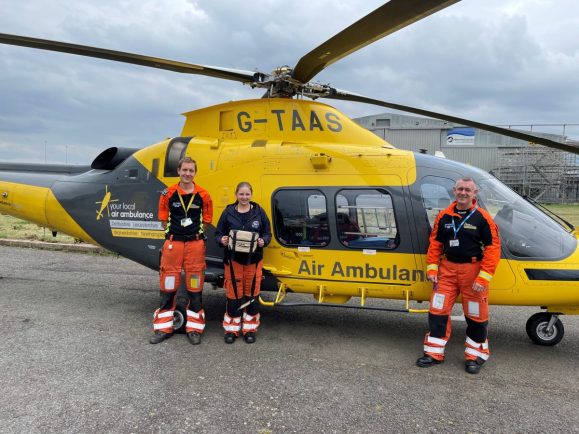
LIFE-SAVING emergency blood transfusions are now part of the service for the Warwickshire and Northamptonshire Air Ambulance (WNAA).
The Air Ambulance Service (TAAS) has begun to transport blood and plasma on board its helicopters and critical care cars.
It means Air Ambulance crews can provide pre-hospital emergency blood transfusions to the many patients they attend who suffer life-threatening bleeding – mostly sustained through road traffic collisions or stabbings.
With traffic collisions making up most of the incidents TAAS has attended over the past 19 years, and with the increase of knife crime throughout its counties, the new service enhances the vital care provided to its patients.
Dr Caroline Leech, a consultant at University Hospital Coventry and Warwickshire (UHCW) and Deputy Clinical Lead for TAAS, said: “For the bleeding patient, blood transfusion is one part of a package of critical care that is provided by our teams to bring advanced resuscitation earlier in the patient’s care before they arrive at hospital, giving them the best chance of survival.
“With data from UHCW showing that two thirds of their major trauma patients who required emergency blood transfusion were treated and transported by TAAS, it has shown there may be a potential benefit in bringing blood to the patient earlier.
“All our doctors and critical care paramedics have received comprehensive training alongside enhanced procedures to be able to deliver the intervention efficiently at the scene.”
The project – a collaboration between University Hospital Coventry & Warwickshire NHS Trust blood transfusion laboratory, the Warwickshire and Solihull Blood Bikes, and Leicestershire and Rutland Blood Bikes – has taken 18 months to come to fruition.
Both WNAA vehicles will carry packed O negative red blood cells (pRBC) which carry oxygen around the body, and Fresh Frozen Plasma (FFP) which contains clotting factors that help to stop bleeding.
There will be a 24-hour rotation of blood products, and any blood and plasma not used by the Air Ambulance will be put back into the blood bank and can be administered to patients in hospital.
TAAS Director of Operations Richard Clayton said: “The introduction of pre-hospital blood transfusions is another positive development in The Air Ambulance Service’s absolute commitment to support the most critically ill and injured patients it has proudly served for nearly 19 years. I am extremely grateful to everyone that has been involved in the project.”
The Air Ambulance Service is not government funded and relies on public donations to remain operational. Visit www.theairambulanceservice.org.uk for more information.