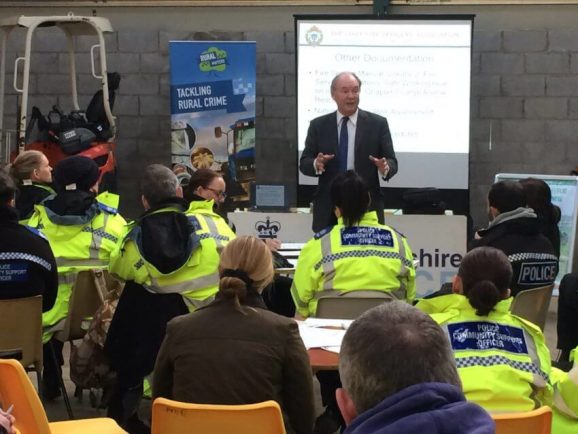
‘SIGNIFICANT challenges’ lie ahead for Warwickshire Police according to the county’s police chief, who is ‘putting pressure’ on the government for more resources.
Speaking exclusively to the Observer, Police and Crime Commissioner Philip Seccombe said the force was under ‘significant strain’ like all public authorities – a strain which was not eased by any commitment to raise general police funding in chancellor Philip Hammond’s budget this week.
Mr Seccombe confirmed the force would be able to recruit up to 50 new officers by next March – thanks to an increase in the police’s share of council tax in Warwickshire.
But if 50 are recruited, the force would have 862 officers – still 111 fewer than it had in 2010.
He said: “I don’t think Warwickshire Police is at breaking point – but I think we have significant challenges going forward.
“I’m not currently in a position to speculate on what next year’s budget is going to be.
“Whatever we end up with, that will be the bottom line. We may have to look at the budget line-by-line if we don’t have the money.”
Warwickshire Police’s budget for 2018-19 is £94.43million – comprising £52.94million in government funding, and £41.49million from council tax.
But Mr Seccombe said the government’s decision in April to use existing police resources to meet a pensions shortfall would reduce his budget by around £1.5million.
And in September last year, the government said a one per cent pay rise for officers would also be funded from existing budgets, costing Warwickshire around half a million pounds in the first year – the equivalent of 12 officers’ annual salaries.
“This could have significant effects,” Mr Seccombe said. “We are putting as much pressure as we can on the Home Office and the Treasury so that they understand if they want to see more police officers, we’re going to struggle to do much more if we’re going to have these additional strains.”
He confirmed that shrinking budgets mean some reported crimes are never investigated, after Channel 4 current affairs programme Dispatches revealed last month just under 33 per cent of crimes in Warwickshire are ‘screened out’ – higher than the national average of 27 per cent.
“We have to prioritise the 999 calls,” he said. “For example, if life is threatened, then sadly it can take preference over a burglary.
“Some of that is sensible, but some of it is forced on us.”
His comments came soon after the chief constables of West Midlands, Greater Manchester and Merseyside forces took the unprecedented step of warning that budget cuts could leave them with officer numbers last seen in the 1970s.
David Thompson, the chief constable of neighbouring West Midlands Police, said: “There is no question there will be more obvious rationing of services. We are struggling to deliver a service to the public. I think criminals are well aware now how stretched we are.”
But Mr Seccombe was keen to sound a note of optimism.
“We have a good, well-led force,” he said. “It’s not all bad news – it’s about priorities, really.
“For example, we’re going to keep all our Safer Neighbourhood Teams, and we have bolstered the number of officers going into patrol.
“We have a new Operational Control Centre opening in Warwick next year, with more sophisticated IT and communication systems which will help in attending more incidents.
“And we have a new incident progression team in the control room, who can deal with some things without needing a visit.”
However, further fears were raised last week when a group of MPs said policing was at risk of becoming ‘irrelevant’.
A report by the Home Affairs Committee said forces in England and Wales were ‘struggling to cope’ amid falling staff numbers and rising crime – accusing the Home Office of a ‘complete failure of leadership’ and warning there would be ‘dire consequences’ for public safety without more funding.
Their fears were echoed in Rugby by Labour’s parliamentary candidate.
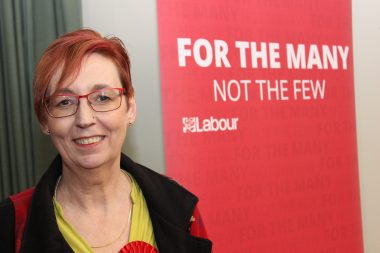 Debbie Bannigan, Labour’s parliamentary candidate for Rugby: “The government is failing in their duty to protect Warwickshire and keep our people safe.”
Debbie Bannigan pointed to Office of National Statistics (ONS) figures released last month which showed a four per cent rise in crime in Warwickshire from June 2017 to June 2018.
She said: “We can’t keep Warwickshire safe on the cheap. The government is failing in their duty to protect Warwickshire and keep our people safe.
“Since they came to power, the Tories have cut over 160 police officers and over 50 police community support officers from Warwickshire. Our force here is now desperately understaffed and overstretched.
“The appalling result is that in just a year robbery went up by 26 per cent, drugs related crime by 12 per cent and theft by five per cent. This can’t go on.”
But Rugby’s Conservative MP argued investment was being made.
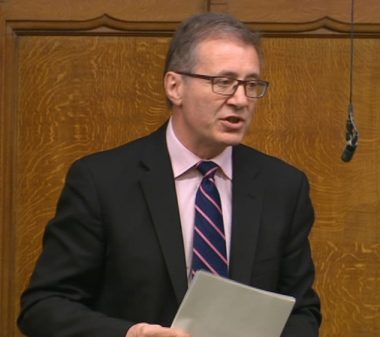 Rugby MP Mark Pawsey: “New technology is innovating policing. Officers can now spend more time focusing on fighting crime.”
Mark Pawsey said: “Far from being cut, public investment in policing has grown by over £1billion in the last two years.
“Also, when analysing the crime statistics from the ONS it is important to note that the recording of crime has greatly improved over recent years. As a result, the police have a much more accurate picture of crime as victims are more willing to come forward and report criminal activity.
“Here in Warwickshire the police are in the process of recruiting a further 50 officers. They have also invested in a new control room which will save on back office costs and allow the force to prioritise frontline policing.
“New technology is also innovating policing. Officers can now spend more time focusing on fighting crime.”
Mr Seccombe said he was lobbying MPs for Warwickshire to get a better deal in the government’s Comprehensive Spending Review next year.
“We would like to see a change in the policing formula,” he said. “We get much less per head than some of the bigger urban forces.
“Nearly half the money we get comes from council tax – but in West Midlands, for example, it’s under 20 per cent.
“There are some sensible reasons why that is so, but it makes it harder for us.
“I will be talking to decision makers – all the Warwickshire MPs, for example – and briefing them on where that could take us.”
He said his budget for next year will be drafted in December and put out to public consultation, and agreed by the end of February to start on April 1.
“I would like to get to the situation where there is police contact and victim support contact for all victims of crime,” he said.
“We have a duty to keep an effective and efficient force, and my job is to give the chief constable enough money to keep Warwickshire safe.
“The residents’ and the community’s interests come first.”